 modopodo
Challenge your assumptions with an AI thinking partner
In short
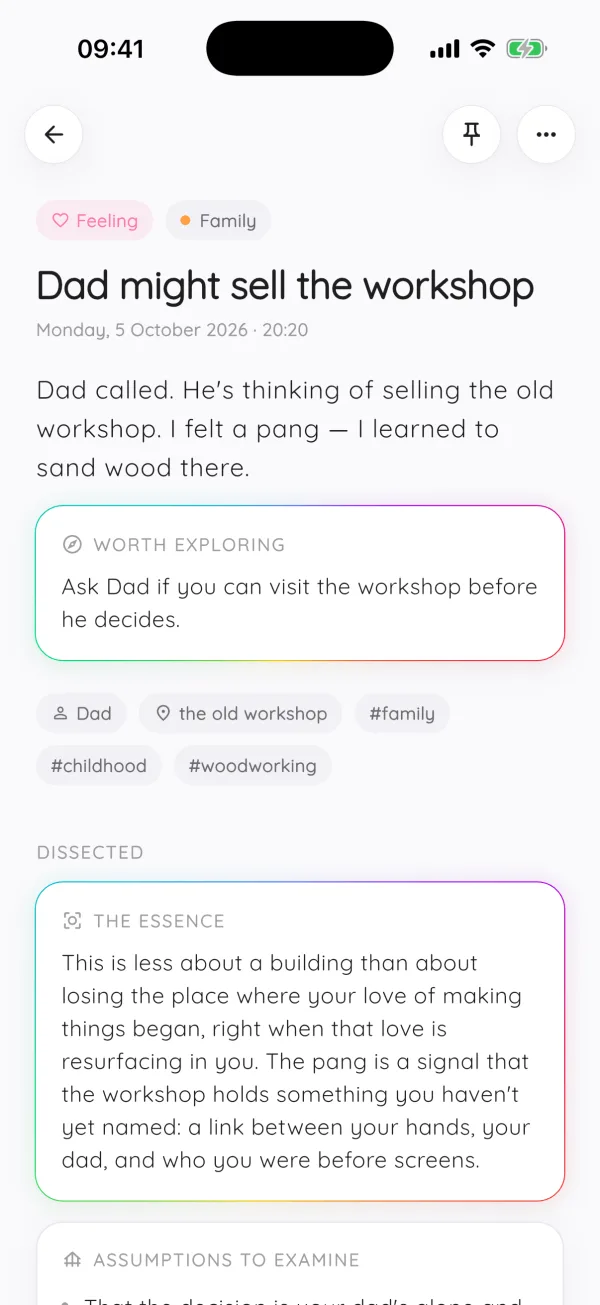
Modopodo helps you challenge your assumptions with one tap. Dissect any note and it returns the thought’s essence, the hidden assumptions behind it, counterpoints, questions to ask yourself, possible next steps and connections to your other notes. It works like a thinking partner that takes your idea seriously enough to push back.
Writing a thought down is half the work. The other half is questioning it: what are you taking for granted, what would someone who disagrees say, and what would you do next? Most people skip that part because it is hard to argue with yourself. Dissect gives you the other side of the argument.
How do I challenge my own assumptions?
Name the beliefs your thought depends on, then ask what would happen if each were false. Modopodo’s dissect does the naming for you, so you can focus on judging.
What does Dissect a note return?
| Part | What it gives you |
|---|---|
| Essence | The core of what you are saying, in a sentence |
| Hidden assumptions | Beliefs the thought quietly relies on |
| Counterpoints | Reasonable arguments against it |
| Questions to ask yourself | Prompts that test the thought |
| Next steps | Small, concrete actions |
| Connections | Other notes of yours that relate |
Example: dissecting a career thought
Your note: “I should quit and freelance. I’m wasting my time in meetings and I’d be happier working for myself.” A dissect of that might look like this (illustrative):
- Essence: You want more control over how you spend your working hours.
- Hidden assumptions: that freelancing means fewer meetings; that the frustration is about the job, not this quarter; that you would find clients quickly.
- Counterpoints: freelancers often spend significant time on sales and admin; a role change inside your company might fix the meeting load.
- Questions to ask yourself: Which meetings drain you most? What would six months of savings change about this decision?
- Next steps: Track meeting hours for two weeks; talk to one person who freelances in your field.
- Connections: a note from March about wanting to lead a project, which pulls in a different direction.
What is an AI thinking partner?
An AI thinking partner is a tool that responds to your ideas with questions and alternatives, not just agreement. Modopodo plays that role in a few ways: dissect for depth on one note, reflections for patterns across many, and “worth exploring” prompts on every note to suggest where to go next.
Why use an app to analyze my thoughts instead of a chatbot?
A chatbot only knows what you tell it in that moment. Dissect also looks at connections to your other notes, so the counterpoint can come from your own past thinking, like a note where you said the opposite. That context is often the most useful part.
How to use a critical thinking journal
- Write the thought as you believe it
Do not soften it. Dissect works best on a clear claim.
- Dissect it
Read the assumptions first; they are usually the most revealing part.
- Answer one question
Pick one of the questions and capture your answer as a new note.
- Do one next step
Small tests beat long deliberation.
This pairs well with journaling prompts for decision making and, if you tend to loop on the same worry, how to stop overthinking.
When is dissecting a note most useful?
| Note type | What dissect helps with |
|---|---|
| A decision you are leaning toward | Surfacing what you are assuming will happen |
| A strong opinion | Hearing the best counterargument |
| A new idea | Finding the open questions and a first small test |
| A frustration | Separating the core problem from the noise |
| A plan | Spotting missing steps and risks |
What are “worth exploring” prompts?
Every note in Modopodo comes with a few follow-up prompts suggesting where to take the thought next. They are lighter than a full dissect: a nudge to write one more note, not an analysis. Use them when you have a minute; use dissect when the thought matters.
Why is it hard to question your own thinking?
Your own reasoning feels obvious from the inside, so the assumptions underneath it are hard to see. Writing helps because it puts the thought outside your head. Getting a structured response to it, with assumptions named and counterpoints spelled out, adds the outside view you would otherwise need another person for.
Dissect does not replace talking to people you trust. It is useful for the many thoughts you would never bring to anyone, or for preparing before you do.
A good habit: when you notice a strong reaction in a note, such as “always”, “never” or “I have to”, dissect it. Absolute words tend to hide the assumptions most worth checking. Capture your answer as a new note, and the two stay connected for the next time the same thought comes back.
Frequently asked questions
How do you challenge your own assumptions?
List the beliefs your thought depends on, then ask what would change if each were false and look for evidence either way. Modopodo’s dissect lists hidden assumptions and counterpoints for any note so you can start there.
Can AI be a thinking partner?
It can be a useful one if it pushes back instead of agreeing. Modopodo’s dissect returns counterpoints, assumptions and questions, and connects the thought to your other notes, but you stay the one who decides.
What is a critical thinking journal?
It is a journal where you do not just record thoughts but question them: what you assume, what argues against it, and what to test next. Dissect gives every note in Modopodo that structure on demand.
Does dissect work on any note?
Yes, you can dissect any note. It is most useful on opinions, plans and decisions, where there are assumptions to surface.
Is the AI analysis always right?
No. AI output can be wrong or incomplete. Use dissect as a starting point for your own thinking, not as advice.