 modopodo
An idea journal for founders who think faster than they file
In short
An idea journal for founders is a single place to capture startup ideas, customer observations, decisions and doubts so you can see how your thinking evolves. Modopodo files each note by theme and threads repeated ideas into growing idea pages with open questions and a next step, so you can test your reasoning before you commit.
Why do founders need an idea journal?
Because your best thinking happens in fragments: after a customer call, on a run, at 1 am. Without one place to catch it, you end up making decisions from memory, and memory flatters whatever you believe this week.
Most founders have the pieces scattered: a Notion page with startup ideas from two years ago, voice memos never transcribed, Slack messages to yourself, a notebook from the offsite. The team wiki is the wrong place for half-formed doubts, and your to-do list is the wrong place for “what if we charged per seat instead?” A founder journal holds that layer: the reasoning, hunches and second thoughts behind the work.
How do you track startup ideas over time?
Capture each version of an idea as it comes, with a date, and periodically pull the versions together to see what changed. Modopodo does the pulling together for you.
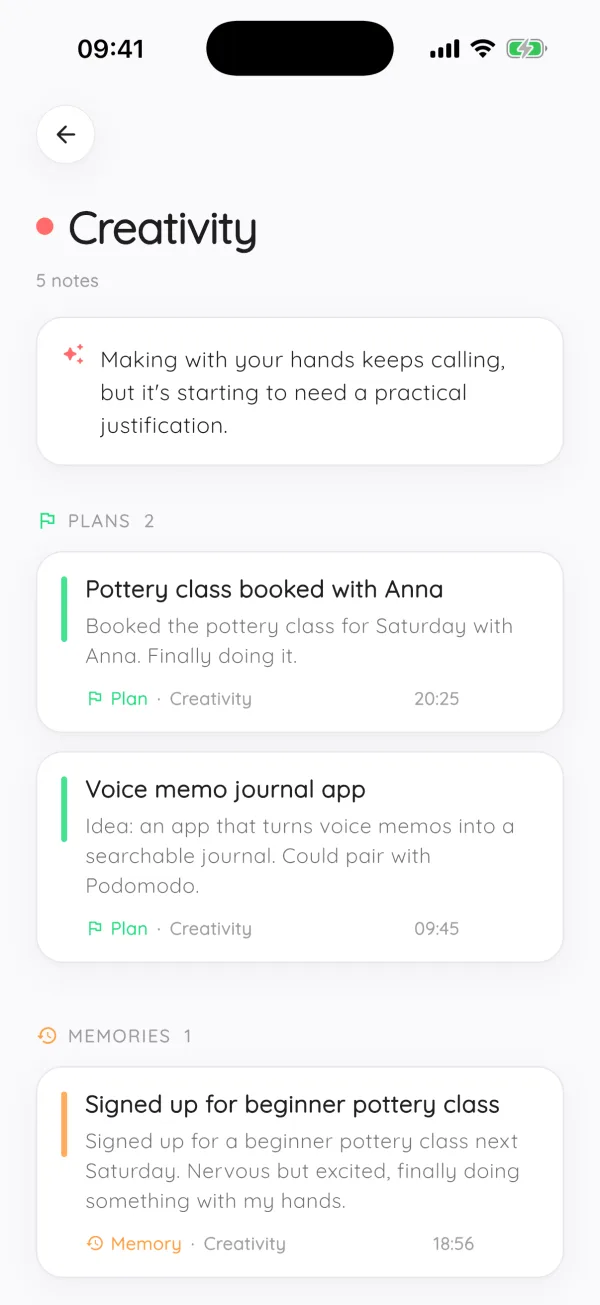
When you keep returning to a thought, Modopodo threads the related notes into a growing idea page. It shows how the idea evolved, where it stands now, the open questions and a suggested next step. Here is how three months of notes about one idea might look:
| Date | What you said | Kind |
|---|---|---|
| March | “Three agencies asked if they can white-label the dashboard.” | insight |
| April | “White-label could be a separate tier. Worried it splits focus.” | idea |
| May | “Agency churn is lower than direct. Maybe they are the real customer?” | question |
| June | “Decided: pilot white-label with two agencies, no custom work.” | plan |
The idea page would collect all four, summarize the shift from “side request” to “possible core customer”, and list open questions like pricing and support load. It’s a record of your reasoning that you can reread before a board update or when a co-founder asks “why did we do this?”
How founders use Modopodo day to day
- Debrief every customer call in 60 seconds
Walk out and say what surprised you. Modopodo tags the person and company it mentions, so you can later browse everything a customer said, by person.
- Dissect a big decision
Before you commit, open the note and use Dissect. You get its essence, hidden assumptions, counterpoints, questions to ask yourself and possible next steps. It is a cheap way to challenge your assumptions before you spend money.
- Ask your notes
Ask “What have I said about pricing since spring?” and get an answer with citations to the exact notes. Useful before investor meetings. More on chatting with your notes.
- Reflect on the founder side, too
Run a reflection across everything and it may surface tensions like “you say focus matters most, yet half your recent ideas are new products”. Pin what rings true.
Founder journaling habits that work without any app
- Write down the prediction, not just the decision. “We’ll get 10 pilots by September” is easy to check later. A decision without a prediction teaches you nothing.
- Separate facts from interpretations. “Two churned customers mentioned onboarding” is a fact; “onboarding is our problem” is a guess. Write both and label them.
- Keep doubts out of the team channel until they’re formed. A private journal is a safe place to think badly first.
- Review monthly. Reread the month’s notes and ask what you now believe that you didn’t before. A weekly reflection works too if you move fast.
- Use a decision journal for big calls. Our journaling prompts for decision making give you a starting template.
What does a founder journal look like after a quarter?
After a few months you have a searchable record of how your thinking changed, organized by theme without any manual filing.
A typical founder might end up with themes like “Pricing”, “Hiring”, “Agency channel”, “Fundraising” and “Energy”, each with a one-line summary of where things stand. Customer names show up in the people view with everything you noted after each call. Two or three growing idea pages hold the bets you keep circling. And a reflection might point out something you wouldn’t write in a board update, like that your notes about hiring got noticeably more anxious in the weeks before payroll grew. None of that requires a template. You just kept talking after the moments that mattered, and the structure came from what you said.
What Modopodo doesn’t do for founders
- It isn’t a team wiki or project tool. There is no collaboration or shared notebooks. Keep specs and roadmaps where your team works.
- It isn’t a task manager or CRM. It notices people and projects in your notes, but it doesn’t track deals, follow-ups or deadlines.
- No importing pitch decks, PDFs or whiteboard photos. It works with what you say or type.
- AI output isn’t legal or financial advice. Use Dissect to sharpen your thinking, not to replace your lawyer or accountant.
If you use Notion for the company and want a private layer for your own thinking, see Notion alternative for personal notes.
Frequently asked questions
What should a founder journal include?
Ideas, customer observations, decisions with the reasoning and predictions behind them, and honest notes on your energy and doubts. The reasoning matters most, because it is what you forget first. Short entries are fine.
What is the best app for startup ideas?
One you will actually use at the moment an idea hits. If you think out loud, a voice-first app like Modopodo captures faster than a structured database, and it groups related ideas over time. If you need to share ideas with a team, use a collaborative tool like Notion instead.
How do I keep track of business ideas?
Capture each idea with a date as soon as it comes, keep everything in one place, and review regularly to see which ideas keep coming back. Ideas that recur over months are usually worth a closer look. Modopodo threads recurring ideas into one page automatically.
Can I share Modopodo notes with my co-founder?
Not inside the app. Modopodo is for personal thinking and has no shared notebooks. You can export your notes as Markdown and share the parts you choose.
Is my startup thinking private in Modopodo?
Notes are stored in the EU, isolated per account, and processed by AI providers whose API terms exclude training on your data. Modopodo has no ads or tracking and never sells data.