 modopodo
A therapy journal app for the days between sessions
In short
A therapy journal app is a private place to record thoughts, feelings and situations between sessions so you remember what to talk about. Modopodo captures these by voice or text, groups them by theme, and can surface recurring patterns you might bring to your therapist. It is a companion to therapy, never a replacement or a crisis service.
Why journal between therapy sessions?
Because a lot happens in a week, and by the time you sit down with your therapist, the details have blurred. A journal keeps the specific moments, so sessions can start from what actually happened rather than what you remember.
It is a common experience: something hits you hard on Tuesday, you think “I need to bring this up”, and on Thursday you sit down and say “it was an okay week, I guess.” Or you leave a session with something important and it fades by the weekend. Many therapists suggest writing between sessions for exactly this reason. Whether you share what you write is up to you and something to decide with your therapist.
Research on journaling as a mental health intervention is encouraging but modest: a 2022 systematic review and meta-analysis of 20 randomized trials found a small overall benefit from journaling interventions and noted that study quality varied (Sohal et al., *Family Medicine and Community Health*, 2022). Journaling supports the work; it doesn’t replace it.
What should I write in a therapy journal?
Specific moments, not summaries. What happened, what you felt, what you thought, and what you did. Things your therapist said that stuck with you, and questions you want to ask next time, are worth noting too.
- Situations: “Dad called and I felt twelve again when he asked about my job.”
- Thoughts: “The thought was: I’ll never be enough for him.”
- Feelings: “Mostly shame, some anger. Tight chest for an hour.”
- Things from the session: “She said I describe rest as something I have to earn.”
- Questions for next time: “Why does this only happen with family?”
How to use Modopodo as a companion to therapy
- Capture in the moment
Tap and talk, even for 20 seconds, while it is fresh. Or type, which works offline. You don’t need to explain or structure anything.
- Let it sort
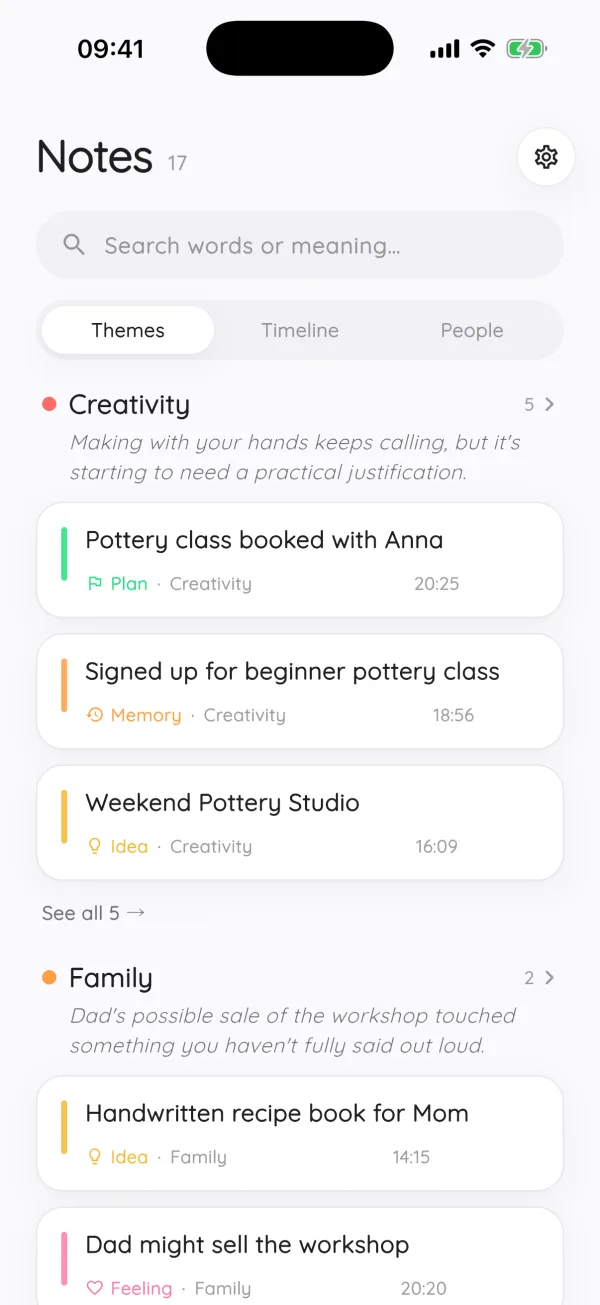
Modopodo gives each note a title and marks it as a feeling, thought, memory, question or reflection, under a theme like “Family” or “Work”. The people you mention are recognized, so you can see everything you said about one person.
- Prepare before your session
Open the timeline or a theme and skim the week. Or ask your notes: “What came up about my dad this month?” The answer cites the exact notes, so you can read them in your own words.
- Notice patterns, then bring them in
A reflection might point out a theme that keeps coming up. Treat it as something to explore with your therapist, not a conclusion. AI output can be wrong and is not clinical advice.
- Capture what you took away
After the session, say one or two things you want to remember. Pin insights that matter so they stay on your Mind page.
Tips for journaling alongside therapy
- Ask your therapist how they would like you to use it. Some suggest specific exercises; follow their lead over any app’s.
- You don’t have to share everything. A journal can be a space for things you aren’t ready to say yet.
- Keep entries short and concrete. Specific details are more useful than long rumination. See how to stop overthinking.
- Stop if it makes things worse. If writing about something leaves you feeling worse, pause and raise it in your next session.
- Notice the good moments too. A therapy journal doesn’t have to be only about problems. Moments when something went better than expected are useful to bring in as well.
Is a therapy journal app private?
This matters more here than anywhere. Modopodo stores notes in the EU (Frankfurt), isolated per account at the database level, and encrypts data in transit. It is not end-to-end encrypted, because the AI has to read a note to organize it, and the maker does not read your notes except to investigate a problem you report or where the law requires it. AI processing uses Anthropic for organization and reflections and OpenAI for transcription; under their API terms, this data isn’t used to train their models. Audio isn’t kept on Modopodo’s servers, there are no ads or tracking SDKs, and data is never sold. You can export everything or delete your account and all data at any time, right in the app. Read more in private AI journal app.
Many people also use Modopodo outside of therapy as a self-reflection app for everyday life.
What Modopodo doesn’t do
- It is not therapy and doesn’t replace a therapist. It doesn’t diagnose, treat or give clinical advice.
- It is not a crisis service and doesn’t monitor your notes for risk.
- No structured clinical worksheets such as CBT thought records or mood scales. You capture freely.
- No sharing with your therapist inside the app. You can export notes as Markdown and choose what to show.
Frequently asked questions
Should I journal between therapy sessions?
Many people find it helpful for remembering what happened and what they want to discuss. It is worth asking your therapist how they would like you to use journaling, since some recommend specific exercises.
Should I share my journal with my therapist?
That is your choice. Some people read a passage aloud or bring a few notes; others keep their journal entirely private and use it to prepare. Both are valid, and you can discuss the approach with your therapist.
What is a thought journal?
A thought journal records situations, the thoughts that came up, and how you felt, so you can notice patterns over time. Some therapists use structured versions as part of treatment. Modopodo is a free-form journal and doesn’t include clinical worksheets.
Can an AI journal replace therapy?
No. An AI journal can help you remember and organize your thoughts, but it can’t provide diagnosis, treatment or the relationship a therapist offers. Modopodo is designed as a companion to therapy, not a replacement.
Is a therapy journal app safe for sensitive thoughts?
Check each app’s privacy policy. Modopodo stores data in the EU, isolates each account, has no ads or tracking, uses AI providers whose API terms exclude training on your data, and lets you delete everything at any time.
What if I’m in crisis?
Contact your local emergency number or a crisis line in your country right away. Journaling apps, including Modopodo, are not designed for emergencies.