 modopodo
A notes app for writers that keeps every story idea findable
In short
A good notes app for writers catches fragments the moment they appear and makes them easy to find months later. Modopodo lets you speak or type a line, character detail or story idea; it titles and files each note by theme, links related fragments, and finds them by meaning, even when you forget the exact words.
Where do writers lose their best ideas?
Mostly between capture and use. You catch the line on a receipt or in a voice memo, and six months later, when the chapter needs it, you can’t find it or don’t remember you had it.
Writers rarely lack material. The overheard sentence on the bus, the image from a dream, the realization that your antagonist wants the same thing as your hero: these show up all the time. They pile up in notebooks, Notes, emails to yourself and memos called “New Recording 47”. A writers idea notebook only works if it keeps those fragments findable when you need them.
How should writers capture ideas?
Fast, wherever you are, and with enough context that future you understands it. Modopodo is built for speed first and adds the context itself.
- Speak the idea. Live transcription means you can say a line of dialogue while walking and see it written immediately. You can switch languages mid-note, which helps if your characters speak another language.
- Let it file. Each fragment gets a title, a kind (idea, quote, thought, memory, question), a theme such as your novel’s working title, and tags for characters or places it mentions.
- Find it by meaning. Search “the scene where the sister forgives her” and find the note even if you said “Mara finally lets it go at the funeral”. That is search by meaning.
- Watch ideas grow. If you keep circling a premise, Modopodo threads those notes into one idea page that shows how it evolved and what is still open.
A writer’s week in Modopodo
| What you captured | Kind | Theme |
|---|---|---|
| “Old man at the bakery: ‘I only buy bread I can’t pronounce.’” | quote | Overheard |
| “What if Mara’s brother wrote the letters, not her father?” | idea | The Salt House |
| “Chapter 4 drags because nobody wants anything in it.” | insight | The Salt House |
| “Smell of my grandmother’s cellar: apples, damp stone, kerosene.” | memory | Sensory bank |
| “Does the essay need the second anecdote at all?” | question | Essays |
Open the theme for your novel and the notes are grouped by kind: ideas in one place, questions in another, quotes and memories nearby. Rename or merge themes as projects change. Modopodo learns from those corrections and files future notes the same way.
Using Modopodo to think through a draft
Capture is half the job. The other half is thinking about what you have.
- Ask your notes
Ask “What have I written about Mara’s father?” and get an answer with citations to the notes it used. It works like a story bible you never had to maintain.
- Dissect a plot idea
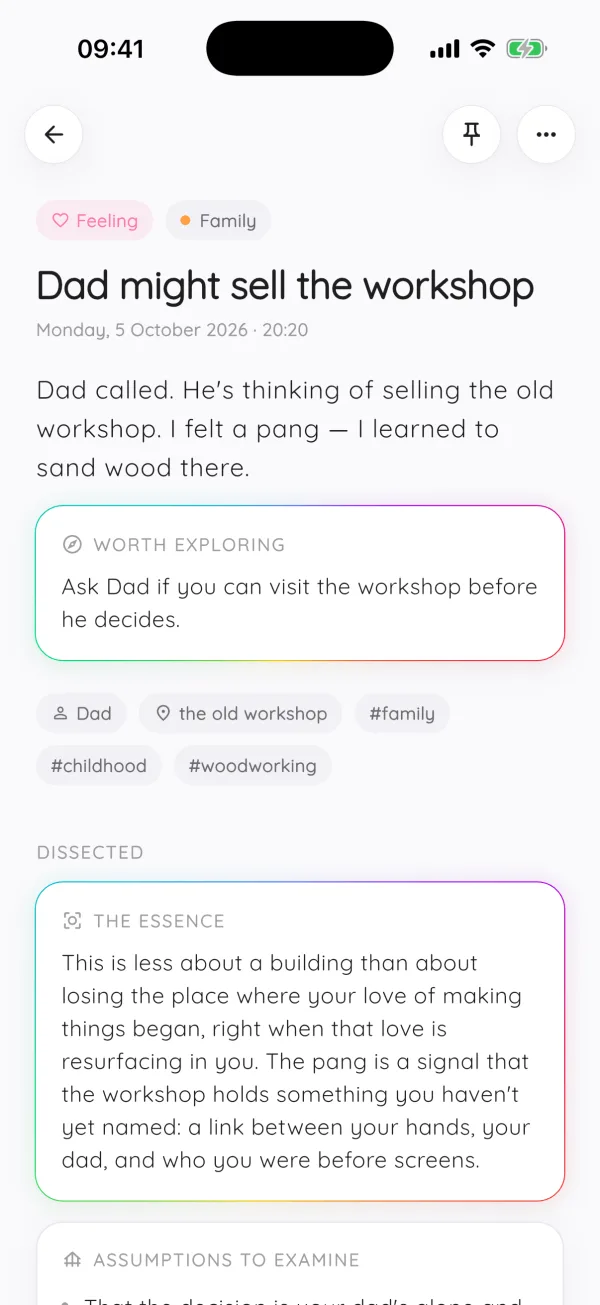
Dissect a note to see its hidden assumptions and counterpoints. “What if the brother wrote the letters?” might come back with “this assumes readers trust the brother; what earned that?”
- Follow “worth exploring” prompts
Every note suggests follow-up questions. Some are good writing prompts.
- Reflect on your process
A reflection across months of notes might point out that you only feel stuck on projects you haven’t told anyone about. Pin it if it lands.
Idea capture habits for writers, with or without an app
- Capture the feeling, not just the fact. “Bakery man, bread joke” is useless in a month. Say why it struck you.
- Keep one inbox. Fragments spread across five apps are fragments you won’t use. See how to remember your ideas.
- Write morning pages if they help you. Some writers use morning pages to clear the noise before drafting. Speaking them works for some people too.
- Reread your fragments before each project. Old notes often contain the missing piece.
Can a notes app replace a writer’s notebook?
For capture and retrieval, often yes. For the pleasure of writing by hand, no, and you don’t have to choose.
Plenty of writers keep a paper notebook for slow thinking and use their phone for the fragments that arrive on the move. The difference is what happens afterward. A paper page stays where it is; a Modopodo note gets a title, a theme and links to related notes, and you can search it by meaning years later. If you love your notebook, consider saying the best lines from it into Modopodo at the end of each week, so they join everything else you can search.
What Modopodo doesn’t do for writers
- It isn’t a manuscript editor. Draft in Scrivener, Word, Google Docs or whatever you like. Modopodo holds the material around the draft.
- It doesn’t write for you. It organizes and reflects on your notes, but it doesn’t generate prose or chapters.
- No handwriting, image or PDF import. Photos of notebook pages or research PDFs stay where they are.
- No shared notebooks. Co-writing teams need a shared tool.
- Export is Markdown. You can take every note with you at any time.
If you like linking notes by hand, a Zettelkasten-style system might suit you. Compare approaches in our Zettelkasten guide and Obsidian comparison.
Frequently asked questions
What is the best notes app for writers?
It depends on whether you need a place to draft or a place to collect. For drafting, use a writing app like Scrivener or Google Docs. For catching fragments quickly and finding them later, a capture-first app like Modopodo, which files and links notes for you, often works better than a general notes app.
How do writers keep track of story ideas?
Most keep one idea notebook or app, capture immediately with a bit of context, and reread regularly. Grouping by project or theme helps, as does tagging characters. Modopodo does the grouping and tagging automatically.
Can I dictate story ideas on my iPhone?
Yes. Modopodo shows your words live as you speak and supports many languages, including switching languages within one note. The transcript is then titled and filed automatically.
Will Modopodo use my writing to train AI?
No. Modopodo uses Anthropic and OpenAI through their APIs, and under those API terms your data is not used to train their models. Modopodo itself has no ads or tracking and never sells data.
Can I export my notes to Scrivener or Obsidian?
You can export all notes as Markdown, which Obsidian reads directly and most writing apps can import. There is no direct sync with Scrivener.