 modopodo
A learning journal app that helps what you learn stick
In short
A learning journal app is where you record what you learned in your own words so you can review and connect it later. Modopodo lets you speak or type a takeaway after a book, course or conversation; it files it as a learning by topic, links related notes, and answers questions from everything you have captured, with citations.
Why do we forget most of what we learn?
Because reading or listening is not the same as processing. If you never put an idea into your own words and never revisit it, it fades, no matter how good the book was.
You finish a great podcast on the commute, highlight half a book, sit through a workshop. A month later you remember that it was good, but not what it said. Highlights don’t help much because they are someone else’s words. A learning journal asks one simple thing: after you learn something, say what it means to you, then come back to it.
What should go in a learning journal?
Short entries in your own words: the idea, why it matters to you, and where it connects to something you already know. One to three sentences per entry is plenty.
- The takeaway: “Spaced repetition works because forgetting a little makes the next recall stronger.”
- The application: “I could use this for my Spanish vocab instead of cramming on Sundays.”
- The question: “Does the same apply to skills, like guitar, or just facts?”
- The connection: “This sounds like what my running coach said about recovery days.”
- A quote worth keeping, with where it came from.
How to keep a learning log with Modopodo
- Capture right after
Close the book or end the call and talk for 30 seconds. Live transcription keeps up, and you can mix languages if you are learning one.
- Let it file
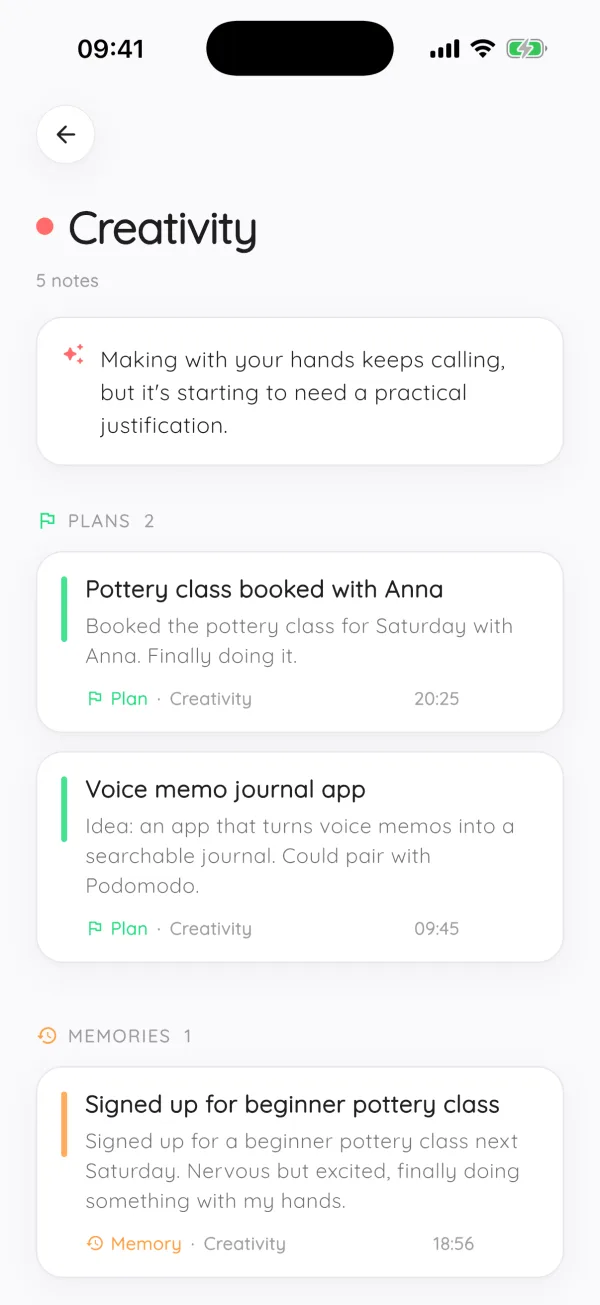
Modopodo marks the note as a learning, quote, question or insight, gives it a title and puts it under a theme like “Spanish”, “Investing” or “Design”.
- See it connect
Every note shows related notes, so the coach’s advice on recovery shows up next to the article about spaced repetition.
- Ask your notes
Ask “What have I learned about habit formation?” and get a summary drawn from your own notes, with citations. It is a useful way to review before you teach, write or decide something.
- Follow the open questions
“Worth exploring” prompts on each note suggest what to look into next.
| Note | Kind | Theme |
|---|---|---|
| “Compound interest only feels slow at the start.” | learning | Investing |
| “‘Time in the market beats timing the market.’ (from the index fund book)” | quote | Investing |
| “Why do fees matter so much over 30 years?” | question | Investing |
| “Realized I’ve been treating savings and investing as the same thing.” | insight | Investing |
Learning journal habits that work with any tool
- Explain it, don’t copy it. Putting an idea in your own words is where most of the learning happens.
- Capture within minutes. Ideas fade fast, so talk on the walk out of the lecture or the minute the episode ends.
- Write questions, not just answers. Open questions give you something to look for next.
- Review on a schedule. A short weekly reflection where you reread what you learned beats occasional marathon reviews.
- Link ideas across fields. The best insights often come from connecting topics. A Zettelkasten does this by hand; Modopodo suggests related notes automatically.
Who is a learning journal for?
Anyone learning on purpose: students reviewing courses, professionals keeping up with a field, career changers, language learners, and people who read a lot and want more to stay with them. If you are building a broader system for everything you know, see how to build a second brain.
How is a learning journal different from taking notes?
Notes record what the source said. A learning journal records what you understood, what it changes for you, and what you still don’t get.
Class or meeting notes are useful for reference, but they tend to be long and passive. A learning journal entry is short and personal: “The chapter on loss aversion explains why I keep my old gym membership.” That small act of connecting an idea to your own life is what makes it easier to remember and use. It also makes your notes far more useful to search later, because they are written in the words you naturally think in.
Over time the journal becomes a map of your own learning. In Modopodo, a reflection across months of entries might show that you keep returning to the same question from different angles, or that two topics you studied separately share an idea. That is often where your most original thinking starts.
What Modopodo doesn’t do for learning
- No flashcards or spaced repetition. Use Anki or a similar app for drilling facts. Modopodo is for understanding and connecting ideas.
- No PDF, image or handwriting import. You can’t upload lecture slides or photos of your notebook. Capture your takeaways by voice or text.
- No highlight sync from Kindle or read-later apps.
- No shared study notebooks. It is built for one person.
- AI answers come from your notes only and can be incomplete. Check important facts against the original source.
Frequently asked questions
What is a learning journal?
A learning journal is a record of what you learn, written in your own words, along with how it applies to you and what questions it raises. It is used in schools, professional development and self-study to make learning stick. Entries can be short.
What is the best app for a learning journal?
One that makes capture quick and review easy. Modopodo suits people who want to speak takeaways right after learning and have them sorted by topic and connected automatically. If you need flashcards, pair it with a spaced-repetition app.
How do I write a learning journal entry?
Note what you learned, why it matters to you, and one question it raises. Use your own words rather than copying. Two or three sentences is enough.
How often should I review my learning journal?
Weekly works well for most people, with a deeper look monthly. Regular short reviews help more than rare long ones. In Modopodo you can also ask your notes a question to review a topic in seconds.
Can Modopodo import my Kindle highlights?
No. Modopodo works with what you say or type and doesn’t import highlights, PDFs or images. Many people find that saying the takeaway in their own words is more useful than the highlight anyway.