 modopodo
How to Find Patterns in Your Journal: A Step-by-Step Method
In short
To find patterns in your journal, reread entries in batches rather than one at a time, tag each entry with a few consistent labels (mood, energy, people, topics, triggers), and count what repeats. Look for things that appear three or more times, then write one sentence per pattern and test one small change. Patterns only show up across many entries.
Most people who journal never reread what they wrote. That is a shame, because a single entry tells you how you felt on a Tuesday, while fifty entries can tell you why your Tuesdays keep going badly. The insight is in the repetition, and repetition is only visible when you look at many entries together.
This guide gives you a practical method for analyzing your journal entries, from a simple monthly reread to a more structured tagging system, plus what to do once you have found something. It works for handwritten journals, notes apps and voice journals alike.
Why look for patterns in your journal?
Patterns show you what reliably affects you: the situations, people, habits and thoughts that keep producing the same results. Seeing them is the difference between journaling as venting and journaling as a tool for change.
Some of the most useful patterns are invisible in the moment. You might not notice that you feel low every time you skip a morning walk, that every frustrated entry mentions the same project, or that you have written about wanting to change jobs every few weeks for a year. Rereading turns these from vague feelings into facts you can act on.
What kinds of patterns should you look for?
Look for anything that repeats: emotions, triggers, people, times, topics, beliefs and wishes. The table below lists the most useful types with examples of what they look like in practice.
| Pattern type | What to look for | Example |
|---|---|---|
| Emotional | Feelings that repeat | “Anxious” in most Sunday entries |
| Trigger | What happens right before a mood | Low mood after late nights or skipped meals |
| People | Who shows up in good vs hard entries | Same colleague in every frustrated entry |
| Timing | Days, times or seasons | Energy dips mid-afternoon; worse in winter |
| Recurring thoughts | Ideas or worries you keep returning to | “Should I go back to school?” every few weeks |
| Beliefs | Phrases you repeat about yourself | “I always mess this up” |
| Wants | Things you keep saying you want | Writing more, moving cities, calling a friend |
| Energy | What gives and drains energy | Better days after time outside |
How to analyze journal entries: a 6-step method
You can do this once a month in about an hour. The first time takes longer; after that it gets fast.
- Gather a batch of entries
Pick a period long enough for patterns to show, at least four weeks. Put everything in one place: notebook, notes app, voice transcripts. Patterns hide when entries are scattered across apps.
- Read without judging, once through
Read the whole batch in one sitting, like you are reading someone else’s diary with sympathy. Don’t analyze yet. Just notice what stands out and what surprises you.
- Tag every entry
Go back and give each entry a few short labels from a consistent list: main mood, energy (high, medium, low), people mentioned, topics (work, health, family, money, creativity) and any trigger. Keep the list short so you actually use it.
- Count what repeats
Tally your tags. Which moods, people and topics come up most? Which tags appear together? Anything that shows up three or more times is worth a closer look.
- Write one sentence per pattern
Turn each candidate into a plain statement: “When I sleep less than seven hours, I write about feeling behind.” Mark how confident you are. Some patterns will be strong, others just hunches.
- Pick one to test
Choose a single pattern and design a small experiment for the next few weeks. Then keep journaling and see whether anything changes. This is how insight turns into change.
How to spot recurring thoughts
Recurring thoughts are ideas, worries or questions that come back again and again. They are often the most important pattern in a journal, because they point at something unresolved.
To find them, look for the same question phrased in different ways (“should I leave?”, “is this the right job?”, “what if I started over?”), the same person or situation in many entries, and the same wish that never turns into action. Once you see one, ask yourself what would have to happen for this thought to stop coming back. Sometimes the answer is a decision. Our journaling prompts for decision making can help with that. Sometimes it is a worry that needs a different approach, which our guide on how to stop overthinking covers.
What your word choices can reveal
Beyond topics, the way you write can be a clue. Research by psychologist James Pennebaker and colleagues analyzed the language people used in expressive writing studies. In their review, Pennebaker and Chung report that people who benefited from writing tended to increase their use of insight and causal words, such as “realize,” “understand” and “because,” over the course of writing, and to shift perspective, moving between “I” and words like “we,” “you” or “they.” People who wrote about a topic in the same way every time were least likely to benefit. The authors caution that these are associations, not proof of cause.
You can use this as a rough lens when rereading your own entries:
- Are you building understanding? Look for “because,” “I realize,” “I think the reason is.” If an issue appears often without any of these words, you may be describing it without processing it.
- Are you stuck in one perspective? If every entry about a conflict is only about how you felt, try writing one from the other person’s point of view.
- Are you repeating yourself word for word? The same sentences across weeks can be a sign of rumination rather than reflection.
- Watch your absolutes. Words like “always,” “never” and “everyone” often mark a belief worth questioning.
How to set up your journal so patterns are easier to see
A little structure while you write saves a lot of work when you reread. You don’t need a rigid template. A few consistent habits are enough.
- Date every entry, including the time if you journal more than once a day.
- Add a one-line summary at the top or bottom: what this entry is mostly about.
- Rate mood and energy with a quick 1 to 5 number. Numbers are easy to scan later.
- Use consistent names for people, projects and places so you can search for them.
- Keep everything in one place. A single searchable home beats three half-used apps.
- Answer a few repeat questions each week, as in a weekly reflection, so you can compare like with like.
Can AI find patterns in your journal?
Yes, AI can help by reading many entries at once and suggesting recurring themes, connections and questions. It is fast and good at noticing repetition, but it can be wrong or miss context, so treat its suggestions as hypotheses to check against your own entries.
There are two common ways to do this. The first is pasting entries into a general chatbot. That works, but think carefully about privacy first; our guide is AI journaling safe? explains what to check. The second is using a journal app built for it.
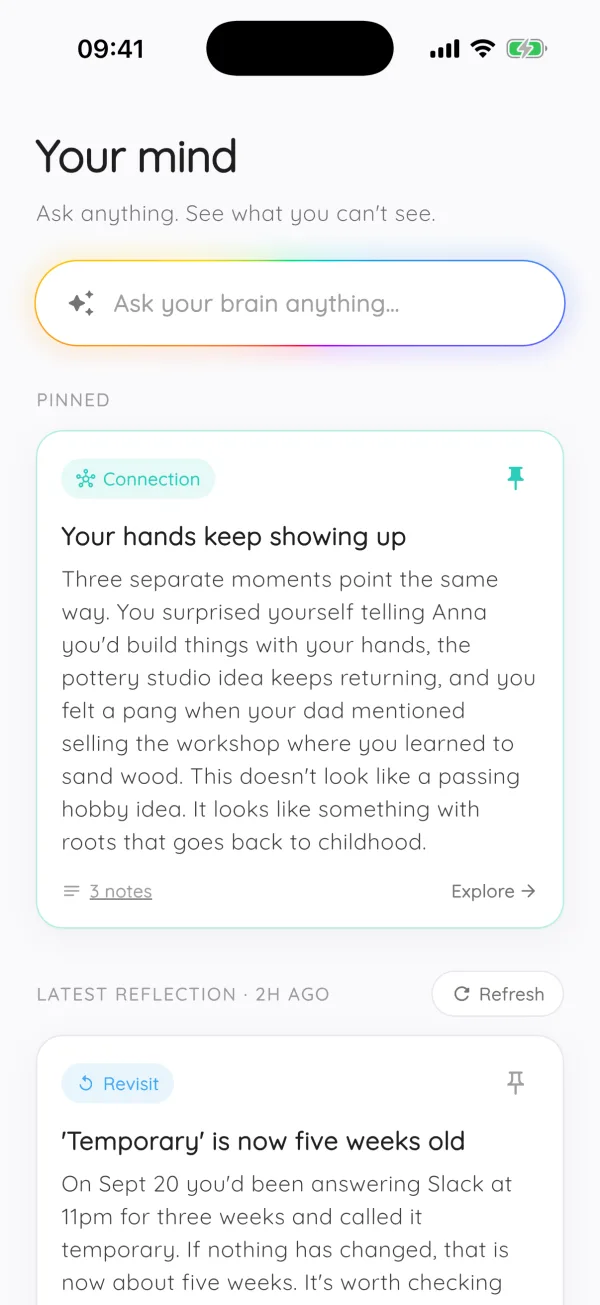
Modopodo is one example. Each note you speak or type gets a title, summary, kind (thought, feeling, plan, question and so on), theme, tags, and the people, places and projects it mentions, which does the tagging step above automatically. When you ask for a reflection, it reads your notes and returns insights, blind spots, tensions, patterns, connections and questions, which you can pin or refresh. You can also ask questions like “when do I feel most energized?” and get an answer with citations linking to the notes it came from, so you can check the evidence yourself. If you keep returning to the same thought, related notes are threaded into one idea page that shows how it evolved.
What to do once you find a pattern
A pattern is only useful if you do something with it. Keep the response small and specific:
- Name it in one sentence and write it somewhere you will see it.
- Decide if it matters. Not every pattern needs fixing. Some are just interesting.
- Pick one small experiment, such as a walk before work for two weeks, or a boundary with the colleague who appears in every frustrated entry.
- Keep journaling and note whether anything changes.
- Review in a month. Keep what worked, drop what didn’t, pick the next pattern.
If a pattern you uncover feels heavy, for example persistent low mood or distress, that is a good reason to talk to a doctor or a licensed therapist. Your journal can be a helpful thing to bring to that conversation.
Frequently asked questions
How do I analyze my journal entries?
Reread at least a month of entries in one sitting, tag each with a few consistent labels such as mood, energy, people and topics, and count what repeats. Turn anything that appears three or more times into a one-sentence pattern, then test one small change based on it.
How often should I reread my journal?
Once a month works well for most people, with a quick weekly look during a weekly reflection. Rereading too often can feel like reliving every entry, while rereading too rarely makes it hard to remember context.
What are recurring thoughts a sign of?
Often they point at something unresolved: a decision you haven’t made, a worry with no plan attached, or a want you haven’t acted on. If recurring thoughts are intrusive, distressing or hard to control, it is worth talking to a professional.
Can AI analyze my journal?
Yes. AI tools can read many entries at once and suggest themes, patterns and questions. Check their suggestions against your own entries, since AI can be wrong, and review how the tool stores and uses your data before sharing private writing.
What should I track in my journal to find patterns?
A few simple things go a long way: the date, a one-line summary, mood and energy on a 1 to 5 scale, the people involved and the main topic. Keeping these consistent makes patterns much easier to spot later.
How long does it take to find patterns in a journal?
Usually at least a few weeks of regular entries. Some patterns, like weekly mood cycles, show up within a month, while others, such as seasonal changes or long-running wishes, take several months to become clear.