 modopodo
A self reflection app that notices what you keep missing
In short
A self reflection app helps you look honestly at your thoughts and behavior over time. Modopodo lets you capture how things went by voice or text, files each note by life area, and on request reads across your notes to reflect back patterns, blind spots, tensions and questions, which you can pin when they ring true.
Why is self-reflection so hard to do alone?
Because you are inside your own story. You remember the moments that fit how you see yourself and forget the ones that don’t, so the same patterns repeat without you noticing.
Maybe you have read the books and made the resolutions. You know you want to be more patient, more focused, less people-pleasing. Then the week happens. By Friday you can’t say whether anything changed, because you didn’t record the moments that mattered. Reflection needs two things: raw material from your actual days, and some distance from it.
How does a reflection app help with personal growth?
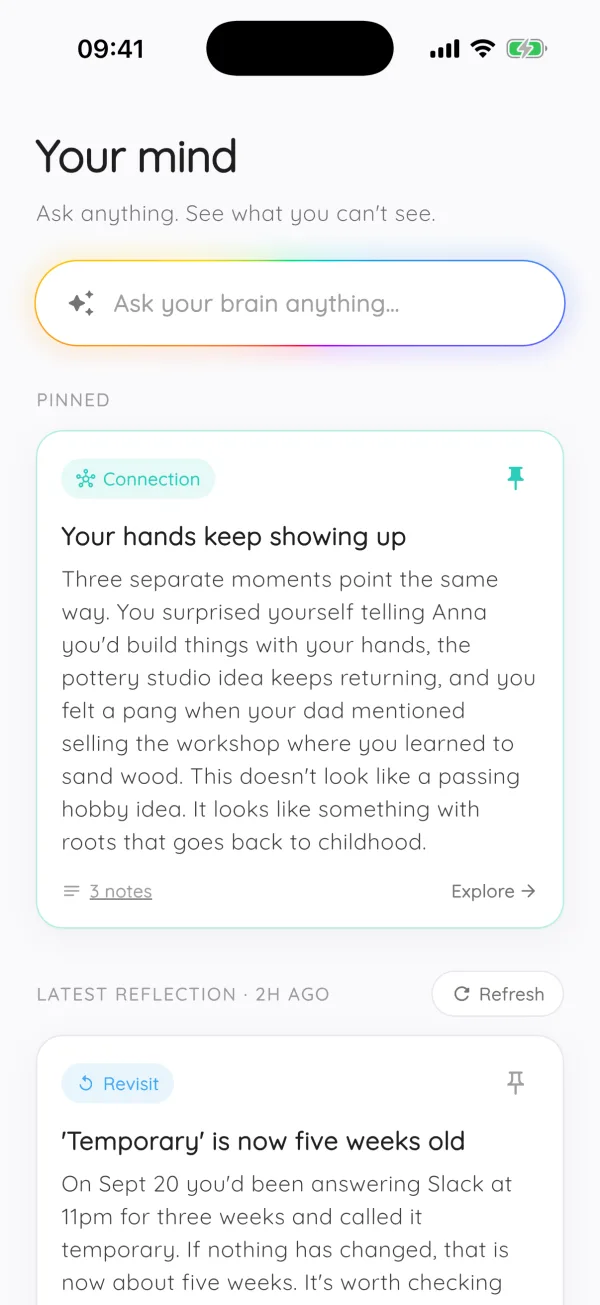
It gives you the raw material (your notes) and some of the distance (a second read). Modopodo collects your notes over weeks and, when you ask, reads across them for things you might not see yourself.
| Type | Example |
|---|---|
| Pattern | You mention feeling drained after every week with more than two evening plans. |
| Blind spot | You describe your manager’s feedback as unfair, but never mention what you agreed with. |
| Tension | You say rest is a priority, yet most plans you note are about doing more. |
| Connection | Your notes on running and on writing both mention starting before you feel ready. |
| Question | What would “enough” look like for you this month? |
These are illustrations of the format, not predictions about you. What comes back depends entirely on what you have captured. Pin the insights that ring true; they stay on your Mind page. Refresh the ones that don’t. The AI can be wrong, and you are the judge.
How to use Modopodo for self-improvement
- Capture small moments
Thirty seconds after a hard conversation, a good day or a decision. “Felt proud I said no to the extra project” is a perfect note. Modopodo files it as a feeling, reflection or insight under a theme like Work or Relationships.
- Browse by life area
Each theme shows a one-line summary of what is going on in that part of your life. Glancing across them is a quick health check.
- Dissect the sticky thoughts
When a belief keeps coming back (“I’m bad at money”), use Dissect to see its hidden assumptions, counterpoints and questions to ask yourself.
- Reflect every week or two
Ask for a reflection after you have a few weeks of notes. Pair it with a weekly reflection routine.
- Follow ideas that grow
If “change careers” keeps coming up, Modopodo threads those notes into one idea page that shows how your thinking evolved and what is still open.
Self-reflection questions that work in any journal
Concrete questions tend to be more useful than big abstract ones. Try these, out loud or on paper:
- What did I do this week that I want to do more of?
- When did I feel most like myself, and what was happening?
- What did I avoid, and what was I afraid would happen?
- What did someone say that I keep thinking about?
- What is one belief about myself that this week contradicted?
For more, see our journaling prompts for self-reflection and the guide on how to find patterns in your journal.
How long before reflections become useful?
Give it a few weeks of regular notes. Patterns need repetition to show up, so a reflection after three entries will have little to work with.
A realistic rhythm is two or three short notes a day, whenever something happens that you have a reaction to. After two to four weeks, ask for your first reflection. Read it slowly. Some insights will feel obvious, a few will feel wrong, and occasionally one will name something you hadn’t put into words. That last kind is worth pinning. Over months, your Mind page fills with insights you have confirmed yourself, which is a more honest record of growth than a list of resolutions.
It also helps to come back to old notes. Reading what you said about a situation six months ago, next to what you say now, is often the clearest evidence that you have changed. Browsing a theme’s timeline makes that easy. If a single question keeps resurfacing, such as whether to move cities, Modopodo threads those notes into one idea page, so you can see how your thinking shifted and what is still unresolved.
What Modopodo doesn’t do for personal growth
- It isn’t a coach or therapist. It reflects your own notes back to you; it doesn’t set goals, hold you accountable or give professional advice.
- No habit tracking, streaks or mood charts. If you want to check off daily habits, use a habit tracker alongside it.
- It only knows what you tell it. Reflections are as honest as your notes.
- AI output can be wrong or incomplete. Treat it as a second opinion, not a verdict.
Frequently asked questions
What is the best app for self-reflection?
The best one is the one you will keep using. If you like guided prompts, a prompt-based journal fits. If you prefer to talk freely and get patterns reflected back from your own notes, Modopodo is designed for that.
How do I start self-reflecting?
Start small: after something meaningful happens, note what happened, how you felt and what you would do differently. After a few weeks, reread your notes and look for repeats. Specific moments are more useful than general judgments about yourself.
Can AI help with self-reflection?
It can help you notice patterns across many entries that are hard to see one at a time. It can also be wrong, because it only sees what you wrote. Use AI reflections as prompts for your own thinking, not as conclusions.
How often should I reflect?
A quick note daily or whenever something happens, plus a longer look weekly, works for many people. In Modopodo you can ask for a reflection whenever you want.
Is Modopodo a replacement for coaching or therapy?
No. It is a tool for organizing and reflecting on your own thoughts. For professional guidance, work with a coach or a licensed therapist; some people use Modopodo between therapy sessions.